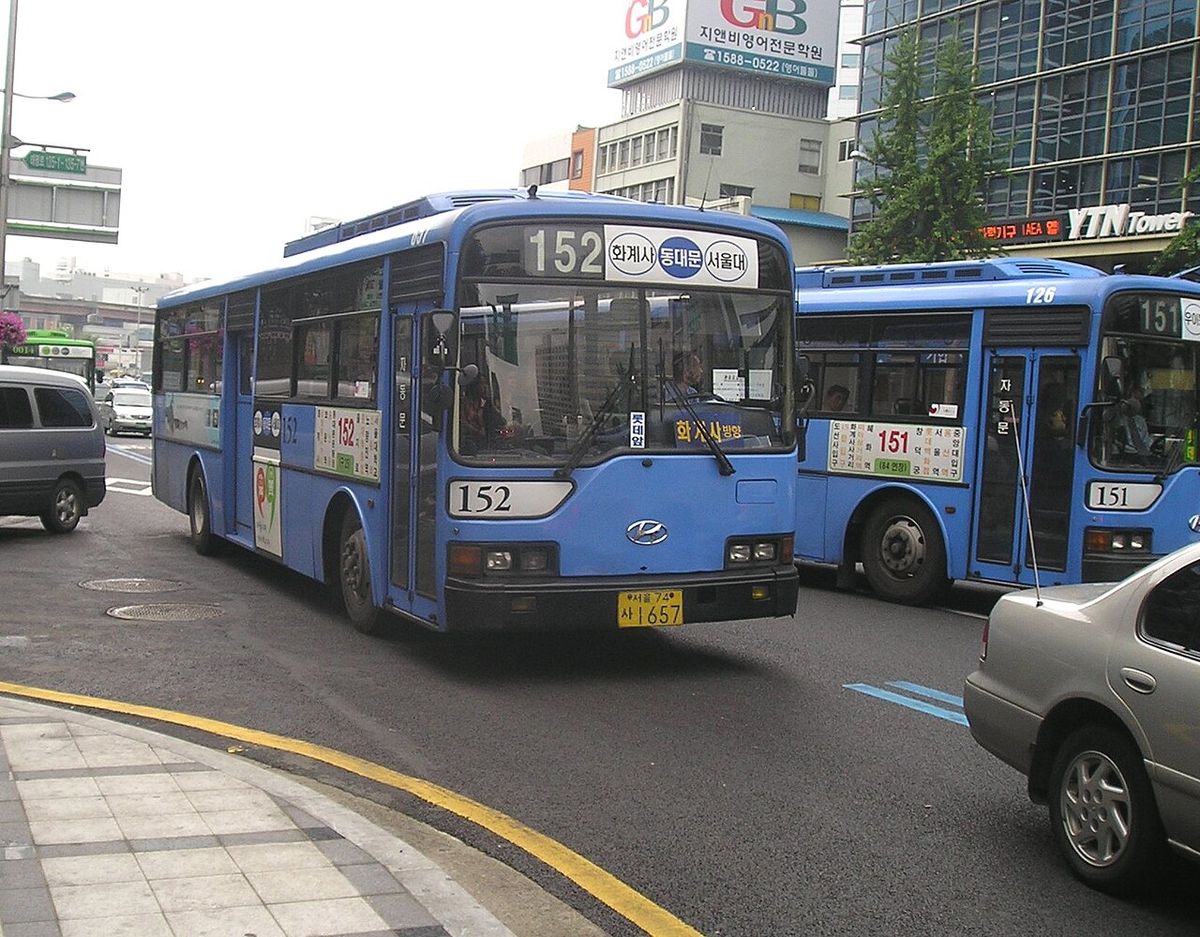
Seoul city buses are color-coded by the kind of route they run. Blue buses run longer routes within Seoul, green buses link neighborhoods to the subway or other buses, yellow buses circle the central districts, and red buses are express buses to nearby metropolitan areas. Night buses carry an N before the route number.
Most rides cost about 1,500 won with a transit card. Tap the card when you board and again when you get off.
Seoul bus colors and fares at a glance
The fares below are adult prices that you pay yourself, per ride, as of November 2026. Blue and green buses cost 1,500 won, yellow buses 1,400 won, village buses 1,200 won, red buses 3,000 won and owl (night) buses 2,500 won.
| Bus | What it does | Adult fare you pay |
|---|---|---|
| Blue (trunk) | Long routes between outer districts and downtown | About 1,500 won |
| Green (branch) | Connects neighborhoods with subway stations | About 1,500 won |
| Small green (village) | Short loops inside a neighborhood | About 1,200 won |
| Yellow (circular) | Short loops around central Seoul | About 1,400 won |
| Red (wide-area) | Seoul to Gyeonggi-do and beyond | About 3,000 won |
| N (night/owl) | Late-night routes after the subway stops | About 2,500 won |
Distance can add a little on longer trips. The red bus is the one to watch: red buses cross into Gyeonggi-do and the fare jumps to 3,000 won. For sightseeing inside Seoul, you will rarely need one.
Blue vs. green: why the right stop matters
When I first went to Korea, I wondered most about the difference between blue and green buses. They often share nearby stops, but not the same ones. Wait at the wrong one and your bus will simply drive past.
So look for your own route number before you settle in to wait. If your route is not listed on the glass at the back of the shelter, walk to a nearby stop and check there.
Local tip: Small green village buses look similar to green branch buses but cost less and run tiny neighborhood loops. Match the route number to your map app instead of going by color alone.
Local tip: Each stop has an information screen with real-time bus arrivals. If your number is not on it, you are probably at the wrong stop.
How to ride a Seoul city bus
- Get a transit card (T-money or Cash-bee). The card works for the bus, subway, taxi and public bikes. Quite a few routes no longer take cash at all.
- Check your route number and stop name in a map app. Both show which stop to use and how many minutes until the bus arrives, in real time.
- Wait at the stop that lists your route. Raise your hand as the bus approaches so the driver sees you.
- Get on through the front door and tap your card on the reader.
- Press the stop bell, then tap your card on the reader at the back door. The screen inside shows the next stop.
Local tip: Always tap off at the back door, even when no one reminds you. The transfer discount only works if you tapped off the previous ride.
Which card should you buy?
For a few rides, a T-money card is simplest. It costs roughly 2,500–4,000 won for the card itself, plus the fares you load onto it. With a card issued abroad, plan to top up a physical T-money card with cash.
If you will ride a lot in one stay, look at the Climate Card. The short-term pass runs from 5,000 won for 1 day to 20,000 won for 7 days, plus 3,000 won for the physical card. The subway side of this is covered in our Seoul subway guide.
Local tip: Carry some Korean cash for top-ups. Our cash or card guide explains where cash is still needed.
Seoul night buses (owl buses)
The subway does not run all night. It stops around midnight, though the exact time varies by line, station and direction. After that, the N buses take over.
The Owl Bus network has 14 routes as of September 2026, with route-specific trips across roughly 11pm to 6am, for 2,500 won with a T-money card. First and last departures vary by route and stop. N26, for example, connects Hongdae, Sinchon, Jongno and Dongdaemun.
Night buses use the same stop poles as day buses. Look for an N-number on the stop’s route list, as you would for a blue or green bus.
Local tip: Between 9 PM and 7 AM the transfer window is longer. Transfers then get 1 hour instead of 30 minutes, and you cannot transfer between buses with the same route number. Tap off the night bus so the discount can apply to your next ride.
Many night routes pass through party areas and run slower than the subway. Check that your route actually goes near your hotel before you wait.
Waiting at the stop in winter
Bus stops are outdoors, and you will spend time there. When I was in Seoul in winter, the wind made it feel like -15 to -10°C. Indoors, in malls, cafés, restaurants and department stores, it was hot.
Several thin layers worked better than one thick coat. See our Korea winter packing list for more.
FAQ
Can I pay cash on a Seoul bus?
Some routes still take it, but many no longer do. A transit card avoids the problem, so load one before you board.
How do transfers between bus and subway work?
Subway-to-bus, bus-to-subway and bus-to-bus transfers are discounted, up to four transfers in one journey (five rides in total), if made within 30 minutes of tapping off the previous ride (up to 1 hour between 9 PM and 7 AM). You need to use the same card for every leg.
Does the Climate Card cover buses?
Yes, it covers Seoul subways and Seoul-licensed buses. Red buses that run out of Seoul are a different category, so do not assume they are included.
Before you go
Fares and night routes can change, so check the Seoul Metropolitan Government’s public transportation page before you travel.
Sources
- Seoul Metropolitan Government – Public Transportation
- Jung-gu Office – Intra-city Buses
- Korea Sorted – Public Transportation Costs 2026
- Don’t Panic Korea – Riding city buses in Seoul
- Seoul Off Script – Missed the Last Train in Seoul
Featured photo: STA3816, CC BY-SA 3.0, via Wikimedia Commons
