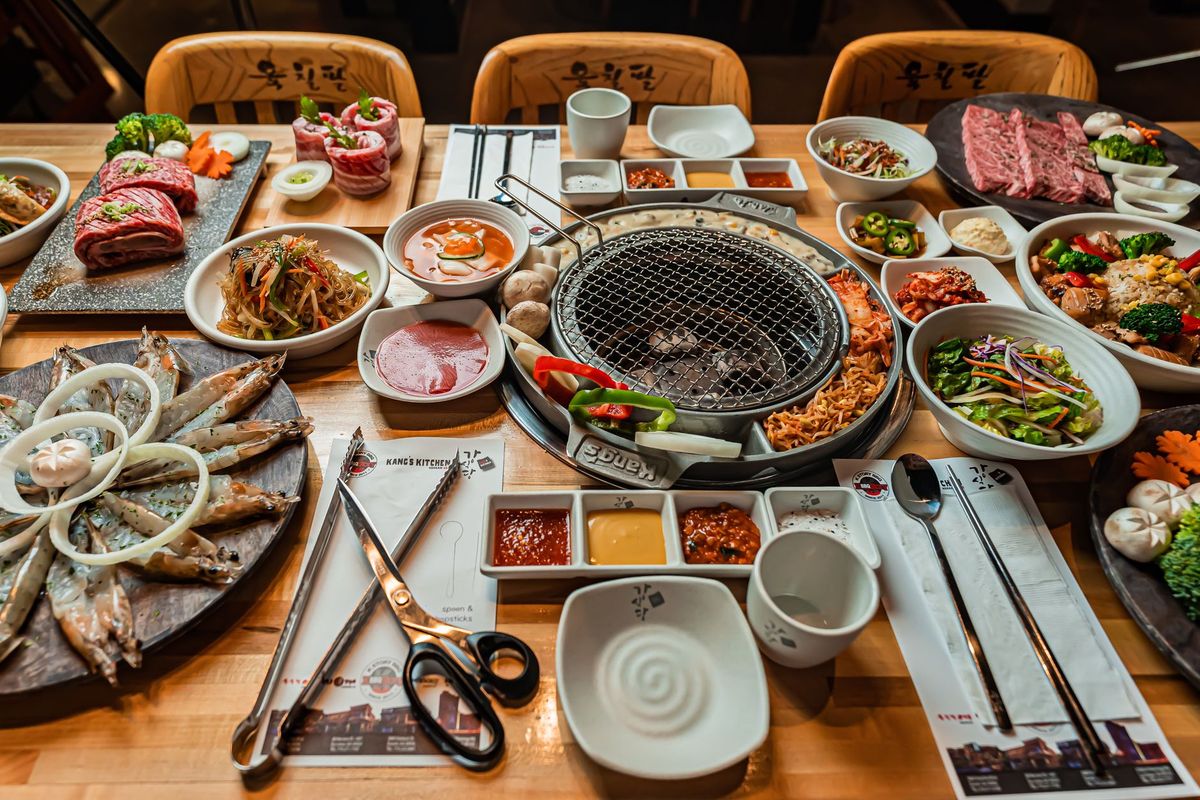
In most Korean restaurants you press a call button (or call out) to order, pay at the front counter when you leave, and do not tip. Menu prices normally include tax, so the price you see is what you pay. This guide walks you through each step.
What to expect when you sit down
Korean meals are built around shared dishes. Your main dish arrives with small side dishes called banchan.
Ordering styles vary, so check how a place works when you walk in. At a standing kiosk you order and pay first, then sit with your receipt. At a table kiosk you sit first, order on the tablet, then prepay or pay at the counter. In traditional restaurants a server takes your order.
English menus are rare, and even when a kiosk has a language option, many dishes may still appear in Korean. A photo menu or a translation app on your phone helps a lot.
How to order, step by step
- Look at the table first. Many Korean restaurants have a small round call button on the corner of the table. Pressing it makes a chime that alerts staff.
- Press it once you are ready to order. Staff will not hover over your table, so you call when you need something. Waiting silently for eye contact usually just means waiting a long time.
- No button? Raise your hand slightly and call out “Jeo-gi-yo” (저기요), which means “excuse me.” A normal speaking voice is fine.
- Check for a tablet or kiosk. In trendy areas like Seongsu-dong and Hongdae, many restaurants use kiosks or tablets at the table for both ordering and payment. Most tablets also have a staff-call button.
- Order, then wait. Dishes usually arrive when they are ready, not in courses.
Water, side dishes and refills
Water is sometimes brought to your table, but it is often self-service. Look for a pitcher, a dispenser or a sign saying 셀프 (“self”). Utensils may also be in a drawer built into the table.
Banchan are free and refillable, and some restaurants have a self-service station for extras. Only ask for what you can finish.
The two-serving minimum when you eat alone
Eating alone is normal in Korea, but some shared dishes have a minimum order. A restaurant can welcome solo diners and still require two portions. This is usually about the table grill or the pot, not about you.
Learn these menu terms:
- 1인분 is one serving, and 1인 세트 is a set for one person.
- 2인분 이상 means at least two servings. 2인 이상 means at least two people.
Your options are to order the minimum and pay for both portions, choose a dish sold per person, or pick another restaurant. Rice soups and bowls such as gukbap and seolleongtang are individual servings, and many casual places serve one-person stews, although house rules vary. Korean BBQ is where the minimum shows up most.
How to pay
In most casual restaurants, do not wait for a bill to arrive, and do not call staff to pay at your table. Take your bill (order slip) to the register at the entrance. That slip is usually placed on or near your table when you order.
Leaving cash on the table and walking out is unusual and can cause confusion. Higher-end and Western-style restaurants are more likely to bring the bill to your table. If you are unsure, ask the staff.
| Restaurant type | When you pay | Where |
|---|---|---|
| Standing kiosk (fast food, casual chains) | Before you eat | At the kiosk |
| Table tablet | Prepay, or after the meal | On the tablet or at the counter |
| Traditional or casual sit-down | After the meal | Front counter, with your order slip |
| Higher-end or Western-style | After the meal | Often at your table |
You pay the menu price in every case, so there is no need to leave change. For what to do if your card is not accepted, see our guides on where you still need cash and which foreign cards work.
Tipping: skip it
You do not tip in Korean restaurants. That applies everywhere, from street food stalls to high-end restaurants. If you leave a tip, a staff member might even follow you out to return the money. A polite thank-you as you leave is plenty.
There is one thing to check on the receipt at fancier places. Some upscale restaurants and hotels add a service charge (봉사료, bongsaryo) of around 10% to the bill automatically. That charge is paid by every customer and goes on the bill, so you owe nothing extra on top. Ordinary restaurants usually do not add it.
Small manners worth knowing
When you pour a drink for an adult, or receive one, use two hands. At group meals, offering drinks to others before filling your own glass is the polite habit. Otherwise, relaxed table manners are fine. Korean restaurants are casual, and nobody expects perfection from a visitor.
FAQ
What should I do if the kiosk rejects my foreign card?
Many foreign Visa and Mastercard cards work in Korea, but a specific kiosk may still reject one. Ask staff whether you can pay at the counter. Carry a backup card and a small amount of cash.
Where do I sit, and do I take my shoes off?
Staff may guide you to a seat or tell you to sit anywhere. Check that a table is not marked 예약석 (reserved). If you do not speak Korean, hold up fingers to show your party size. Most restaurants use chairs, but some traditional spots have floor seating where you remove your shoes.
What if staff bring me a free extra dish?
Koreans call a free extra from the house “service.” Accept it with a thank-you. Do not offer money for it, because that goes against the spirit of the gift.
Which Korean phrases are most useful?
- 물 주세요 (mul juseyo): water, please.
- 반찬 좀 더 주세요 (banchan jom deo juseyo): a little more side dish, please.
- 계산할게요 (gyesan-halgeyo): I’d like to pay.
- 2인분 시킬게요 (i-inbun sikilgeyo): I’ll order two servings.
Before you head out, our convenience store guide covers cheap one-person meals.
Sources
- Hani Seoul: A Guide to Korean Restaurant Etiquette
- Korea Experience: How to Eat Like a Local, Casual Korean Restaurant Etiquette
- The Soul of Seoul: Tipping in Korea
- Why Koreans Eat That: Eating Alone in Korea (Honbap)
- Seoul Plate: How to Order Food in Korea
Practices vary by restaurant, so check the signs and ask staff if you are unsure.