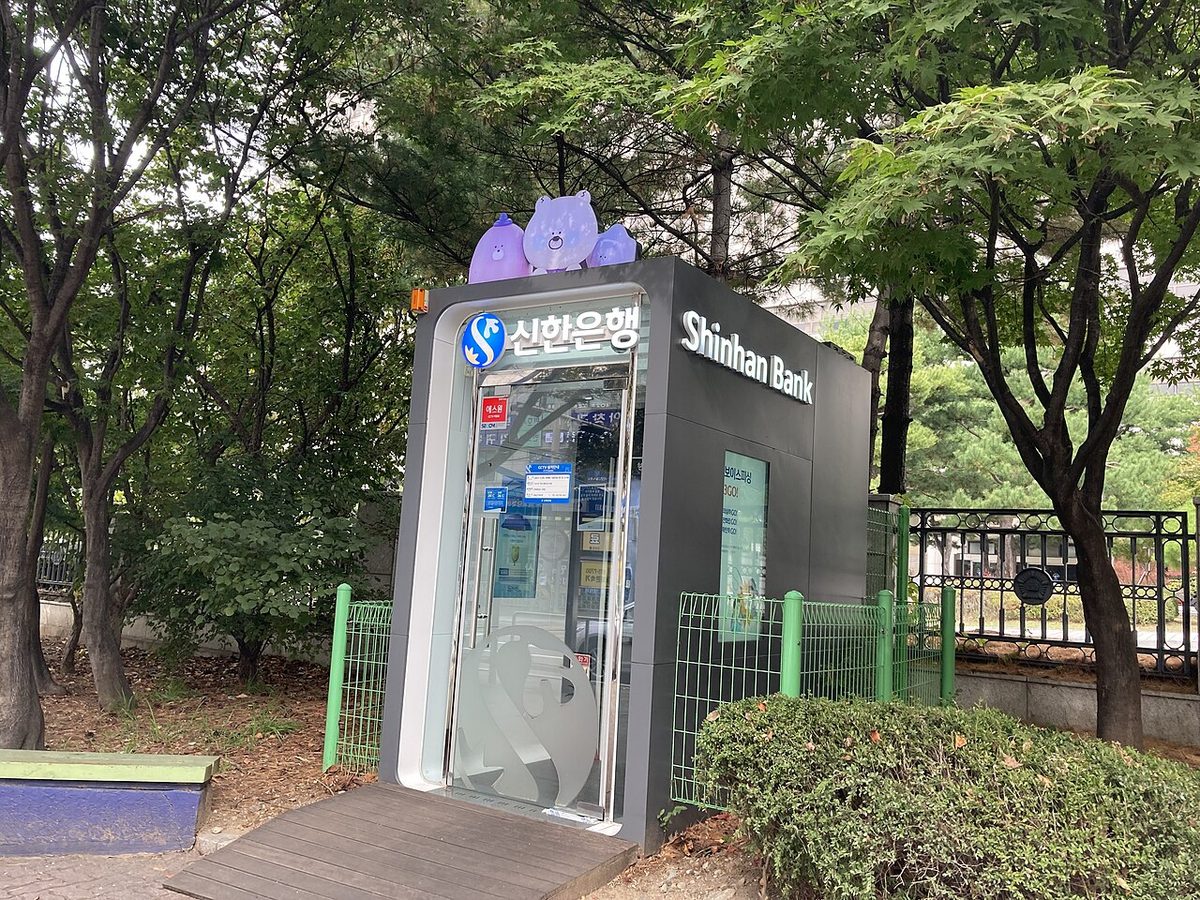
Yes, you can withdraw Korean won with a foreign card, but only at ATMs marked “Global ATM.” Look for the Global ATM sticker, mainly at Woori Bank, KB Kookmin, and convenience stores (GS25, CU, 7-Eleven). Expect charges from both the Korean machine and your own bank.
This guide covers how to find a working machine, what each withdrawal really costs, and how to avoid the most common mistakes. For when you actually need cash, see our guide to where you still need cash in Korea.
Which ATMs in Korea accept foreign cards?
Many Korean ATMs only handle domestic bank cards. The key is the “Global ATM” label (글로벌 ATM). These machines show Visa, Mastercard and Cirrus logos and offer an English menu. If the screen only shows Korean, the machine almost certainly won’t take your card, so move on.
Major banks are the safest bet. KB, Woori, Shinhan and Hana are the most reliable. Convenience store machines are everywhere, but they are less consistent, and some decline foreign cards.
Local tip: Hana Bank’s English ATM page has a tab called “Global ATM (Foreign Card Only)” that lets you search for compatible machines. Open it before you leave your hotel so you are not guessing on the street.
What does an ATM withdrawal cost a foreigner?
You pay up to three layers of charges. The numbers below are approximate figures reported by travel guides in 2026, and they differ by machine and card.
- Korean ATM fee (you pay the Korean bank or operator): guides report roughly ₩3,000 to ₩5,000 per withdrawal. The fee is the same regardless of the amount.
- Your home bank’s charges (you pay your card issuer): a foreign transaction fee plus exchange-rate markup, often 1–3% of the amount. Some banks also add a fixed fee of about $3–$5 per transaction.
- Credit card cash advance (you pay your card issuer): a cash advance fee plus interest from the withdrawal date, on top of the other two layers.
As an example, on a ₩100,000 withdrawal, the Korean ATM fee alone is ₩3,000–₩5,000. With your home bank’s 1-3% foreign transaction fee on top, the total cost is roughly ₩4,000–₩8,000 (4–8%).
Local tip: The receipt does not show your full cost. It typically shows only the Korean ATM fee. Your issuer’s fee and markup appear on your card statement days later.
Withdrawal limits: bank ATM vs convenience store
Your limit is whichever is lower: the ATM’s or your card’s.
| Where | Typical limit per withdrawal | Hours | Good for |
|---|---|---|---|
| Bank branch Global ATM | Up to ₩1,000,000 | Typically 7:00 AM to 11:30 PM | One larger withdrawal |
| Convenience store ATM (CU, GS25, 7-Eleven) | About ₩300,000 (some guides report lower caps) | Run 24/7 | Late-night top-ups |
Because the Korean fee is flat, one bigger withdrawal costs less than several small ones. Withdraw what you need in a single transaction rather than making several smaller ones. For most tourist budgets, ₩200,000–₩300,000 every few days is plenty.
Step by step: using a Global ATM
- Find a machine with a Global ATM label or your card network’s logo (Visa, Mastercard, Plus, Cirrus, UnionPay).
- Choose English or the foreign card option if the screen offers it before you insert your card.
- Insert your card and enter your PIN. Some foreign cards work best with a four-digit PIN.
- Select “Withdrawal” (출금). Choose “Savings” or “Checking”; either works for most foreign cards. Credit cards may show up as a cash advance.
- Enter the amount. Korean ATMs dispense bills only, in ₩10,000 increments.
- Take your card, cash and receipt before you walk away.
The notes you get are mostly ₩10,000 and ₩50,000. For a refresher before you arrive, read our post on foreign credit cards in Korea that work and the ones that don’t.
Local tip: If the ATM offers to convert the amount into your home currency, decline and pay in won. This is called DCC, and it adds an extra 3–5% markup if you accept. Your own bank’s rate is usually better.
Arriving at Incheon Airport
You can get your first won here, but pick the right machine. Bank ATMs in the arrival halls of both Terminal 1 and Terminal 2 (Hana, Woori, Shinhan and others) are the most reliable at the airport. The small machines inside some shops are less dependable for foreign cards.
Take out a modest amount to cover transport and the first day or two. Then top up at a bank in the city. If you also need somewhere to leave bags after landing, see our luggage storage guide.
How to reduce your costs
- Use a debit card, not a credit card, for cash. Credit cards add the cash advance fee and interest described above.
- Consider a travel card. Many fintech travel cards waive ATM fees up to a monthly allowance, for example roughly ₩250,000–₩400,000. The allowance varies by card, and the Korean machine fee still applies.
- Avoid airport and hotel machines for large sums. They are convenient, but card-issuer rates and fees vary, so keep those withdrawals small.
If your card is rejected
Do not keep retrying the same machine. Try these in order:
- Walk to a different Global ATM, ideally a bank-branch machine.
- Try a smaller amount.
- Check that international withdrawals are switched on in your banking app.
- Use your backup card from a different bank or network.
Myeongdong, a busy tourist area, has many Golbal ATMs within a few minutes’ walk. Major banks have branches within a few blocks of exits 5, 6 and 7 of Myeongdong Station. If a machine keeps your card or you lose your wallet, follow our lost passport or wallet guide.
FAQ
Can I use any bank’s card at a Korean ATM?
Not always. Cards from your home bank work through your card network (Visa, Mastercard, UnionPay and others), and only Global ATMs are set up for those networks. Some UnionPay cards with two network logos may not work at every machine, so carry a second card.
Do Korean ATMs give coins?
No. They dispense banknotes only, so you will receive coins only as change when you pay in cash.
Is it cheaper to exchange money than use an ATM?
It depends on your card. With a standard bank card, a flat ATM fee on a small amount is costly in percentage terms. With a fee-free travel card, an ATM is often competitive with exchange counters.
How much cash should I carry?
Cards are accepted in most places, so a small cash buffer is enough for markets and small shops. Withdraw more only when your wallet runs low. Fees and limits vary by machine and card, so check the amounts shown on the ATM screen and your card issuer’s notices before you confirm.
Sources
- Hana Bank: ATM and Global ATM (foreign card) search
- Lacha Korea Guide: How to withdraw cash from Korean ATMs with foreign cards (2026)
- Hani Seoul: Withdrawing cash with foreign cards and avoiding DCC fees
- Korea Locally: Korea ATM cash guide (2026)
- Hello Korea Guide: Which ATMs in Korea accept foreign cards (2026)
Featured photo: Narubaru7, CC BY-SA 4.0, via Wikimedia Commons
