You can learn the basics of Hangul, the Korean alphabet, in about an hour. It has 24 basic letters (14 consonants and 10 vowels), plus 5 double consonants and 11 compound vowels. An hour is enough to start sounding out signs slowly.
You will be able to read the words, but you will not know what they mean. That is still useful. Matching a station name or a menu item to the Korean text is often easier than asking for directions.
Why Hangul is quick to learn
Hangul is not a set of word pictures like Chinese characters. It is a simple, systematic and phonetic writing system. King Sejong the Great invented it in 1443. You can read more about its origins in this Korea.net article.
Each letter stands for one sound. The letters are then stacked into square syllable blocks. Once you know the letters and the stacking rule, you can read almost anything aloud, even before you know the meaning.
The 24 basic letters
Here are the 14 basic consonants, with the sounds you will need most. Some letters change slightly by position, such as ㄱ (g/k), ㄷ (d/t) and ㅂ (b/p).
- ㄱ g/k, ㄴ n, ㄷ d/t, ㄹ r/l, ㅁ m
- ㅂ b/p, ㅅ s, ㅈ j, ㅊ ch, ㅋ k
- ㅌ t, ㅍ p, ㅎ h
- ㅇ is silent at the start of a syllable and sounds like “ng” at the end
Four of them, ㅋ ㅌ ㅍ ㅊ, are stronger versions of ㄱ ㄷ ㅂ ㅈ, so they look related.
The 10 basic vowels are:
- ㅏ a, ㅑ ya, ㅓ eo, ㅕ yeo, ㅗ o
- ㅛ yo, ㅜ u, ㅠ yu, ㅡ eu, ㅣ i
Vowels with a vertical stroke (ㅏ ㅓ ㅣ) sit to the right of the consonant. Horizontal vowels (ㅗ ㅜ ㅡ) sit below it, and a final consonant always goes at the bottom.
How the blocks work
Letters are grouped into one square block per syllable, so ㅎ + ㅏ + ㄴ makes 한 (han). Read each block left to right, then top to bottom, and read the blocks in order.
Every block starts with a consonant, then a vowel, with an optional final consonant underneath. If the syllable starts with a vowel sound, a silent ㅇ fills the first slot, so 아 is “a” and 이 is “i”.
A 60-minute study plan
This plan follows the usual order: vowels first, because they appear in every syllable. Say every letter and block out loud.
- Minutes 0-10: vowels. Learn the 10 basic vowels above. Pair each one with ㅇ (아, 야, 어, 여, 오, 요, 우, 유, 으, 이).
- Minutes 10-25: consonants. Learn them in small batches of three or four. Read each one with ㅏ (가, 나, 다, 라, 마).
- Minutes 25-35: blocks. Combine consonants with other vowels, such as 고 (go), 비 (bi) and 나 (na).
- Minutes 35-45: final consonants. Read blocks with a letter underneath, such as 강 (gang), 남 (nam) and 밥 (bap).
- Minutes 45-55: station names. Sound out the stations in the next section.
- Minutes 55-60: menu words. Read the table further down aloud.
Double consonants (ㄲ ㄸ ㅃ ㅆ ㅉ) and compound vowels (ㅐ ㅔ ㅘ and others) can wait until after the hour. The double consonants are just doubled versions of basic letters, for example ㄷ becomes ㄸ.
Reading subway stations
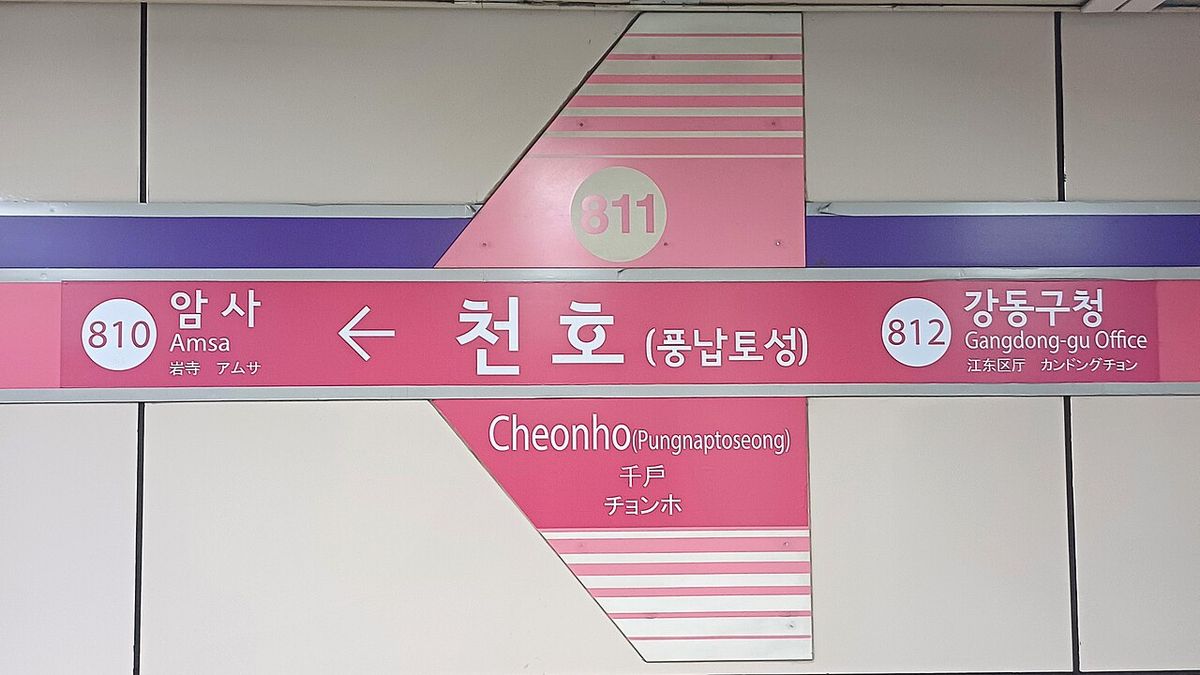
Seoul station signs are a good first test. Each station has a unique number, and its name is written in Hangul, Roman characters and Chinese characters. Outside, entrances are marked with a tall obelisk showing the station name and number.
Try sounding these out before looking at the English:
- 서울역 (seo-ul-yeok), Seoul Station. 역 means station and appears at the end of almost every name.
- 강남 (gang-nam), the Gangnam area and Line 2 station.
- 삼성 (sam-seong), a Line 2 station.
- 이태원 (i-tae-won), a Line 6 station.
- 광화문 (gwang-hwa-mun), a Line 5 station.
- 명동 (myeong-dong), the shopping district.
For lines, transfers and fares, see our Seoul subway guide.
Local tip: Look for the exit number before you walk up to street level. Inside stations, exits are marked “Way Out” with a number on a black circle. Exits can be a long way apart at ground level. Every station also has a map showing which exit is closest to your destination.
Local tip: When you search for your destination in a map app, note its Hangul spelling. Then compare it with the Hangul on the platform signs, not just the English.
Reading menus
Menus are easier than they look because dish names are built from a few repeating word endings. These are worth learning:
- 밥 (bap) means rice.
- 국 (guk) means soup.
- 찌개 (jjigae) means stew.
- 면 (myeon) means noodles.
- 구이 (gui) means grilled.
| Hangul | Sounds like | Meaning |
|---|---|---|
| 비빔밥 | bibimbap | Mixed rice bowl |
| 김치찌개 | kimchi jjigae | Kimchi stew |
| 삼겹살 | samgyeopsal | Pork belly |
| 냉면 | naengmyeon | Cold noodles |
| 불고기 | bulgogi | Marinated grilled beef |
| 떡볶이 | tteokbokki | Spicy rice cakes |
| 물 | mul | Water |
| 맥주 | maekju | Beer |
The words in this table are based on this menu vocabulary list and this food word guide. Banchan (반찬), the side dishes, are listed as free on typical menus.
Local tip: To order, say the dish name followed by 주세요 (juseyo), meaning “please give me.” For example, 비빔밥 주세요 means “Bibimbap please.” To ask for less heat, say 안 맵게 해 주세요 (an maepge hae juseyo), “not spicy, please.”
For paying, tipping and table habits, read our Korean restaurant etiquette guide.
Everyday sign words
A handful of words cover most street signs:
- 출구 (chul-gu): exit
- 입구 (ip-gu): entrance
- 화장실 (hwa-jang-sil): toilet
- 편의점 (pyeon-ui-jeom): convenience store
- 약국 (yak-guk): pharmacy
- 병원 (byeong-won): hospital
Pharmacy and hospital signs are worth recognizing before you need them.
Local tip: Do not worry if your sounding-out does not match the English spelling. Sounds shift by position, and the Roman spelling on signs is only a guide. If the Hangul matches the Hangul on your map app, you are in the right place.
After the hour
Practice by reading everything you pass: shop names, menu boards, platform signs. Most learners can read Hangul slowly within about a week at around 30 minutes a day. Speed comes quickly, because you will see the same words over and over.
FAQ
Do I need to learn Hangul to travel in Korea?
No. Subway stations show Roman letters next to the Hangul. Reading the Korean is a bonus that helps most at restaurants, small shops and street signs, where English is less common.
Should I learn to write as well?
For travel, reading is enough. Writing by hand helps the letters stick, but you can skip it.
What is the hardest part for beginners?
Usually the vowels that look alike, such as ㅓ and ㅏ, and ㅗ and ㅜ. Check the stroke direction: it tells you whether the vowel is vertical or horizontal, and so where it sits in the block.
Will I understand Korean after this?
No. You will be able to read words aloud, and many place names and loanwords will sound familiar. Food names are the best early wins.
Sources
Before you go, check the official Seoul Metro site for current station information.
- Korea.net: King Sejong the Great’s gift to Korea: Hangeul
- Lingrow: How to Learn Hangul
- KoreanKorea: Korean Alphabet Chart
- Kaiwa: How to Read a Korean Menu
- Wikipedia: Seoul Metropolitan Subway stations
Featured photo: Striker9498 This photo was taken with Samsung Galaxy A34 5G, CC0, via Wikimedia Commons
