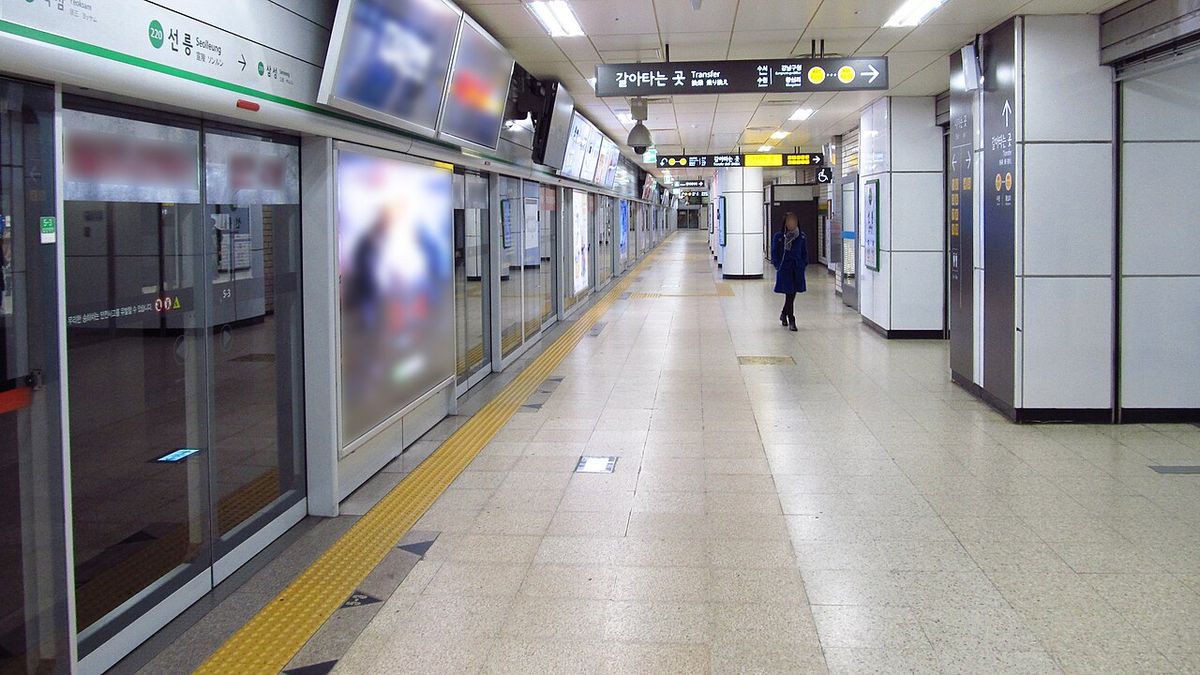
Public restrooms in Korea are generally free and well maintained. The easiest place to find one is a subway station, and the next best are department stores, parks and public buildings.
This guide covers where to look, how to search on your phone, the toilet paper rule that confuses most first-timers, and what to do at night or in winter.
Are public toilets free in Korea?
Yes. Restrooms in subway stations, parks, city halls and shopping districts are free and usually stocked with toilet paper and soap. Public toilets have no coin gate, and visitors and residents pay the same price: nothing.
Private businesses are different. A small independent business may limit its restroom to customers. A café or restaurant toilet is meant for people who bought something there.
Where to find a public toilet
Look for the universal men/women sign or the word 화장실 (hwajangsil). Here is how the main options compare.
| Place | What to expect |
|---|---|
| Subway stations | Almost every station has a public restroom. Locations vary, so signs matter (see below). |
| Department stores and malls | Often the best public restrooms: clean, free, large and comfortable. |
| Parks, palaces, museums | Free restrooms at palaces, libraries, museums, parks such as Han River Park and Namsan Park, and tourist information centers. |
| Large buildings | Look for a small blue “Public Restroom” (개방화장실) sign. Seoul buildings of five stories or more have public restrooms on the first floor. |
| Police boxes (지구대 or 파출소) | Open 24 hours and found in almost every neighborhood. |
| Gas stations | Almost always let you use their toilets, and many are open 24 hours. |
| Convenience stores | Not all have a public restroom. Some are staff-only or customer-only. Treat them as a last resort. |
Toilets inside a building follow that building’s hours. Naver Map lists many restrooms inside places like post offices or gas stations, which may be closed outside business hours. For more on what convenience stores offer, see our convenience store guide.
Subway station toilets: inside or outside the gates?
This is the detail that catches visitors out. Restrooms may be inside or outside the ticket gates, so check the station signs before tapping through. At large transfer stations there are often restrooms both inside and outside the fare gates, so you can use one without a ticket.
If you are inside and the only toilet is outside, you have two options:
- Press the help bell next to the wide gate. Tell the station attendant you need the restroom and they will open the gate for you.
- In the Seoul area, tap out and back in. If you tap back in at the same station, through the same line’s gates, within 15 minutes, you are not charged the base fare again.
On lines like AREX and the Shinbundang Line, ask station staff before you leave the gates. Our Seoul subway guide explains fares and transfers in more detail.
Local tip: At the help bell, say “hwajangsil” (화장실) and point to the toilet sign or your phone screen. Staff are used to the words “Restroom” or “Wrong way.” You do not need to explain more.
How to search for a toilet on your phone
Search before it becomes urgent. Public toilets can be plentiful in central neighborhoods but less obvious after dark.
- Open Naver Map or KakaoMap. Both work much better than Google Maps in Korea.
- Type 화장실 or 공중화장실 (public toilet). You can also search “toilet” in English.
- Tap a result and check the opening hours before you walk over.
A dedicated app is another option. Korea Toilet (나는 화장실이 급하다) uses Korean government open data and user reports to find the closest restroom you can use right now. It can filter for open-now, accessible and baby-room restrooms.
Flush the paper or use the bin?
Old advice says never flush toilet paper in Korea. That is now outdated for public toilets. The government removed trash cans from public restrooms starting January 2018.
In most public stalls, including those in subway stations, parks, department stores and recently renovated toilets, used paper goes in the toilet. The small bin in women’s stalls is for sanitary products.
Older places can differ. Older buildings and some small restaurants still ask you to use the bin. Two signs are worth recognizing:
- 휴지는 변기에 버려주세요 means put the toilet paper in the toilet.
- 휴지는 휴지통에 버려주세요 means put it in the wastebasket.
The words to spot are 변기 (toilet) and 휴지통 (wastebasket). Our Hangul reading guide will help you read other signs too.
Local tip: Check for paper before you lock the stall door. Toilet paper sometimes runs out, or it is placed outside the stall. In some toilets it sits near the entrance or the sinks. A small pack of pocket tissues in your bag solves this.
Local tip: Flush only toilet paper. Never flush wet wipes or paper towels. Cleaners also report that covering the seat with lots of tissue clogs toilets.
What the stalls are like
Most are sit-down toilets. Some squat toilets exist. You will rarely meet one in a city.
Don’t expect a bidet in a public stall. An ordinary subway or park stall usually does not have one. Hotels and newer buildings are more likely to.
Cafés, restaurants and door codes
Many cafés and restaurants sit in buildings with a shared toilet. It may be on another floor, outside the shop, or need a door code. Ask the staff when you order, and they will usually tell you where it is or give you the code.
For restaurant manners in general, see our restaurant etiquette guide.
At night and in winter
Subway toilets are not a safe bet at 2 a.m., because stations close after the last train. At night, a police box or a 24-hour gas station is the more dependable choice.
Winter changes what you want from a toilet stop. Indoor places such as shopping malls, cafés, restaurants and department stores were hot. Thin layers worked better than one thick coat, so a warm department store toilet is an easy place to adjust your clothes. Our winter packing list has more on layering.
Local tip: Carry hand sanitizer as well as tissues. Some restrooms do not provide toilet paper and soap. Festival grounds and older market toilets are the most likely to run short.
FAQ
Do I need coins or a purchase to use a public toilet?
No. Public toilets in stations, parks and public buildings are free to use. Only a private business such as a café may expect you to be a customer.
Are there accessible toilets and baby changing rooms?
Yes. Korea has accessible toilets in most major train and subway stations, large tourist attractions and some indoor venues. They are usually near the main toilets and easy to reach. The Korea Toilet app also lists baby changing tables.
Are men’s and women’s toilets separate?
Yes. Look for 남자 (men) and 여자 (women) on the door, alongside the pictogram.
What if I am between stations and desperate?
Get off at the next station and look for the toilet signs. If the toilet is outside the gates, use the help bell or the 15-minute re-entry rule described above.
Sources
- Look at Korea: How to Find a Toilet in Korea Fast
- Seoul Explorer: Finding public restrooms in Seoul
- Look at Korea: Korean subway re-entry rule
- The Korea Herald: Waste bin-free public restrooms
- Google Play: Korea Toilet app
Featured photo: LERK, CC BY-SA 4.0, via Wikimedia Commons
