In Korea, a foreign Visa or Mastercard handles most of your spending, but you still need Korean won for a few jobs. Cash top-up remains the most reliable option for a T-money transit card at convenience stores and many subway stations. Some traditional-market stalls may also still be cash-only.
The simplest plan is one main card, a backup card, and a modest cash reserve. This guide covers where cash still matters and how to get it. It also covers how to spend it before you fly home.
Where a card is enough
Most shops and restaurants, and much of the tourist infrastructure, are set up for cards. Many shops accept cards, including shops in Gwangjang and Namdaemun markets. For which cards usually work and which get declined, see our guide to foreign credit cards in Korea.
The trouble is the exceptions. They are small, but you run into them early in a trip.
Where you still need cash
| Situation | Cash needed? | What to do |
|---|---|---|
| Topping up a T-money card | Yes, in practice | Don’t assume a foreign-issued credit card can top up a standard physical T-money card. Bring won. |
| Some Seoul city buses | Cash may not be accepted | Some Seoul bus routes may not take cash. Ride with a transit card. |
| Traditional market stalls | Often | Some stalls may still be cash-only. Carry small notes and ask before you order. |
| Street food carts and tiny snack shops | Often | Check for a card reader. If there isn’t one, ask or pay in cash. |
| Older coin lockers, vending machines, small rural businesses | Sometimes | Machines and small businesses vary. If you don’t see a card reader, assume cash. |
Step 1: Get Korean won
The easiest way to get cash is an ATM, but not every Korean ATM accepts foreign cards. You need a multilingual machine with a “Global ATM” sign in English at the top.
- Find a machine with the Global ATM sign. Look for one near your arrival point so you have cash before your first transit ride.
- Insert your card and choose English.
- If the screen offers to convert the amount into your home currency, choose Korean won (KRW). Accepting the machine’s conversion usually costs you more.
- Check the fee on screen, then withdraw the amount you need in one go, since one large withdrawal is usually cheaper than several small ones.
Two sets of fees can apply, and you pay both. A Global ATM’s single-withdrawal limit is typically ₩300,000 to ₩1,000,000, and a machine fee of ₩3,500 to ₩5,000 applies. Your home bank may add its own charges, such as a fixed fee of $3–$5, a 1% brand fee and a 1–3% markup. Limits and fees differ by machine and bank, so check the screen and ask your bank before you travel.
Step 2: Set up your T-money card with cash
T-money is the rechargeable card for subways, buses and many convenience stores. It is the one place where almost every visitor needs won. T-money also has separate products and mobile services with different payment methods, so what’s available depends on the product. T-money’s own English guide says to check its official site for the latest top-up and refund details.
- Buy a physical card at a convenience store. Whether you can pay for the card itself by card is covered in the FAQ below.
- Hand the card to the cashier and say how much to add. Top-ups usually go in ₩1,000 increments, and there is a cap on the balance per card.
- Pay the cashier in cash and check the balance on the receipt.
- Top up again before the balance gets low. Subway station machines also work, but some top-up machines are cash-only, so keep won on hand either way.
If your Seoul route is mostly bus-based, note that the city publishes a list of cashless bus routes, in Korean and dated January 2026, covering 183 numbered routes. On those routes you may not be able to pay with cash. A loaded T-money card means the question never comes up.
Step 3: Spend or refund the balance before you leave
Unused T-money balance can be turned back into cash, but it isn’t free. A convenience-store refund pays out the balance minus ₩500, in won. That ₩500 fee comes out of your money, and you receive the refund in cash.
Store limits depend on the brand. One guide lists GS25 under ₩20,000, 7-Eleven ₩20,000 or less, and CU and emart24 ₩30,000 or less. Larger balances, up to ₩50,000, can be handled at a subway station customer service center or T-money Town. Brand limits and fees can change, so confirm with the store or T-money. The simplest approach is to spend the last few thousand won on a snack or drink.
Markets and street food: how to handle them
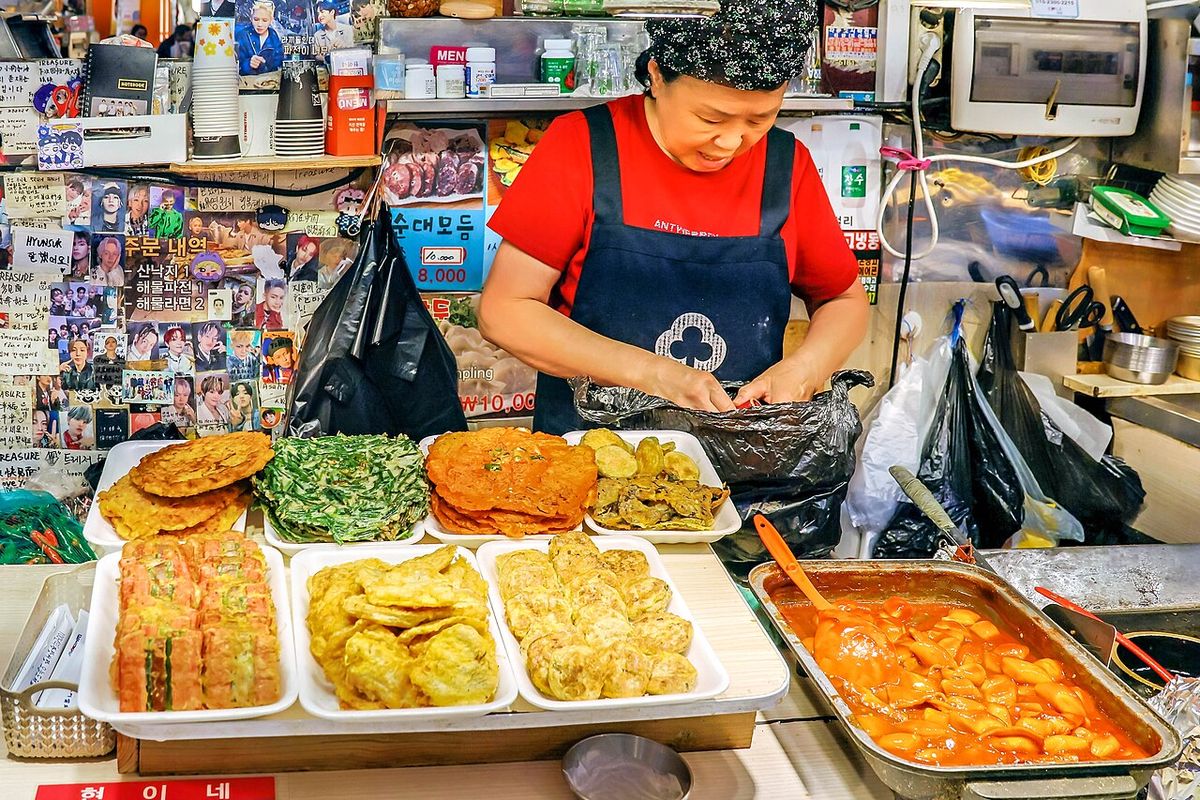
Gwangjang and Namdaemun are the markets most visitors head to. Cards are accepted at many shops, but a stall selling a ₩5,000 pancake may not have a reader. Korea Tourism Organization guidance notes that some traditional-market stalls and street shops may only accept cash.
A few habits help:
- Carry small notes rather than one big bill, since small stalls may not have much change.
- Ask before you order, not after the food is ready. “카드 돼요?” means “Can I pay by card?” “현금만 돼요?” means “Cash only?”
- If a stall is cash-only and you’re short, walk to a nearby convenience store with a Global ATM. Don’t leave the cashier waiting.
How much cash should you carry?
There’s no single right number. Think in three parts: your first T-money load, spending money for market and street-food days, and a small emergency reserve. Cards cover the rest.
Carrying a smaller amount is safer than carrying a large one. Keep your backup card and some reserve cash in a different place from your main wallet, so one loss doesn’t leave you with nothing.
FAQ
Can I pay for the T-money card itself with a foreign card?
Sometimes. At a convenience store you usually need Korean cash, and whether a foreign card works for the card purchase varies by store. Plan to pay in won to be safe, and treat a card payment as a bonus.
What if a Global ATM rejects my card?
Try a different Global ATM, ideally one in a bank branch or a busy tourist area, since machines differ. Then contact your home bank to check that overseas withdrawals are enabled and what your daily limit is. If you can, bring a second card from a different bank as a backup.
Should I worry about cash if I only plan to see Seoul’s main sights?
You’ll still want some, mainly for the transit card and any market visit. Everything else can usually go on a card. Check your own route for market or street-food stops, and bring cash for those.
Is a cash-only shop a sign that something is wrong?
Not at all. Small vendors may simply not have a card terminal. Ask politely and have a note ready, or look for a nearby shop that takes cards.
Sources
- T-money: Can You Use Tmoney at Convenience Stores? (2026)
- Lacha: T-money Card Buying, Charging and Refunds (foreigner guide)
- Korea Sorted: How Much Is Public Transportation in Korea? 2026 Fares
- Hani Seoul: Withdrawing Cash from Korean ATMs with Foreign Cards
- TravelerPick: Korean Traditional Markets, Gwangjang and Namdaemun Guide
Featured photo: Dr. Thomas Liptak, CC BY-SA 4.0, via Wikimedia Commons
