The easiest way to reach Jeju is a domestic flight from Seoul. Gimpo to Jeju flights run every 15-30 minutes and take about an hour. Once you land, a rental car gives you the most freedom, but the island’s buses cover the main sights if you don’t want to drive.
This guide covers the flight, the documents you need for a rental car, bus and taxi costs, and how to split Jeju into regions so you don’t waste time on the road. Prices below are what visitors pay out of pocket, as of November 2026.
Getting to Jeju
Most visitors fly. Seoul-Gimpo to Jeju is the busiest domestic flight route in the world. You rarely need to book far ahead outside peak holidays, but fares change with season and how early you buy.
Seoul and Jeju are in the same time zone, so there is no jet lag to plan for. Book flights directly with the airline or through a flight search site. Domestic flights usually require your passport as ID at check-in.
Is a day trip from Seoul worth it?
It is possible, but not great. After airport time on both ends, you’re left with roughly 6-8 hours on the ground, enough for one region’s highlights. If you can, stay at least a couple of nights.
Which season?
Jeju changes a lot between a mild spring and a windy winter. Our month-by-month guide to Korea will help you pick dates. If you travel in cold months, the winter packing list applies here too.
Renting a car in Jeju
A car makes sense if you want to see the east coast, the south and the mountain area in a few days. As a foreign visitor you need paper documents at the counter. You need your home-country license and a physical, paper IDP (International Driving Permit) together. Digital versions and photos are not accepted, and you must get the IDP before you fly.
Local tip: Bring your passport, your original home license and the paper permit booklet, plus a payment card in the driver’s name. Korea accepts valid International Driving Permits issued by countries in the 1949 Geneva Convention or the 1968 Vienna Convention. The counter will not hand over keys without a permit of an accepted type.
Age, residents and cost
Minimum age and driving-experience rules vary by company and vehicle class. Standard cars commonly start at age 21, while larger vans may require an older driver. Rental companies may limit IDP-based rentals to the first year after entry into Korea, so long-term residents should check whether they need a Korean or exchanged license.
For the daily rental fee, one 2026 guide quotes a rough range of ₩45,000–150,000 per day. You pay this directly to the rental company, and the price depends on the car and the season. Insurance, fuel and charging are extra costs.
Insurance
Ask what the quoted price includes. For a short trip on unfamiliar roads, the Super CDW or full-coverage upgrade is usually recommended, since it lowers your out-of-pocket risk for covered damage, though exclusions and limits still apply. Photograph the car inside and out at pickup and return, and keep your paperwork.
Driving and navigation
Do not rely on Google Maps for driving. Download KakaoMap or Naver Map before you arrive; both are free, have English interfaces, and give turn-by-turn navigation plus live warnings for speed zones. A local data plan helps, so see our eSIM vs SIM vs pocket WiFi comparison.
Local tip: Jeju has a lot of speed cameras and slow school and residential zones. Fines arrive by mail to the rental company and get passed on to you. Let the app warn you and keep to the posted limit.
Getting around without a car
Buses reach most sights, but they take longer and you plan around timetables. A local bus costs 1,150 KRW by transit card or 1,200 KRW in cash, and express buses cost 2,000–3,000 KRW depending on distance. The airport limousine bus 600 costs 1,300–5,500 KRW depending on how far you ride. Each rider pays these fares at boarding.
| Option | Typical cost (paid by you) | Best for |
|---|---|---|
| Rental car | Roughly ₩45,000–150,000 per day before insurance and fuel | Multi-region trips, small groups, flexible timing |
| Bus | ₩1,150–3,000 for most city and express rides; limousine 600 ₩1,300–5,500 | Solo travelers, Jeju City, Seogwipo, one or two sights |
| Taxi | Airport to Jeju City roughly ₩6,000–10,000; airport to Seogwipo or Jungmun often ₩40,000 or more | Short hops, late arrivals, heavy luggage |
Those sample trips come from a 2026 transport guide. By bus, the airport to Jeju City center is about 1,150 KRW, the airport to Seogwipo or Jungmun is about 5,000 KRW by limousine, and Jeju City to Seongsan is about 3,000 KRW by express bus. Taxi figures are approximate.
Local tip: Buy a transit card (T-money) at the airport and load it with cash before you leave the terminal. Card fares are cheaper than cash fares on regular buses. Our cash vs. card guide explains where you still need bills.
Where to go: a region-by-region plan
Jeju is a big island, so group your days by region. Mixing east and west in one day means a lot of driving.
East: Seongsan Ilchulbong
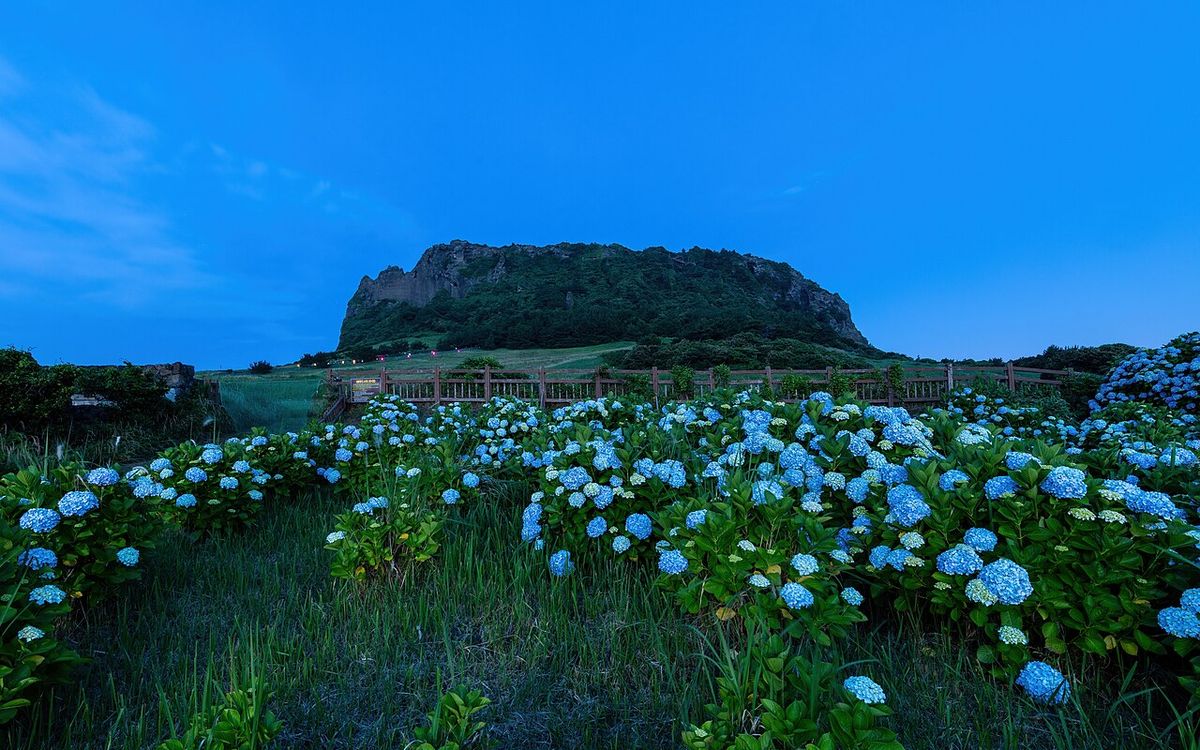
Seongsan Ilchulbong is a UNESCO-listed volcanic cone on the east coast, and it is the island’s best-known sunrise spot. Adult entry to the summit trail is ₩5,000.
Opening hours and ticket cut-offs shift by season, and it closes the first Monday of every month. Plan your east-coast day around that closure. Nearby, many visitors add Manjanggul Cave and the Seopjikoji coast for a full day.
Center: Hallasan
Hallasan is South Korea’s highest mountain, and the summit needs planning. You can’t climb to Baengnokdam without an advance reservation for the Seongpanak or Gwaneumsa trail. Foreigners can book with email verification, with no Korean phone needed.
Daily quotas are 1,000 for Seongpanak and 500 for Gwaneumsa (as of August 2026). Reservations go through the Hallasan reservation system, which Jeju Province runs. Weekends and peak seasons fill quickly, so book as soon as your dates are fixed.
Local tip: At the trail entrance, use your reservation number at the kiosk to issue a QR code. There are also time limits on the way up. Checkpoints close the summit direction at 11:30 AM in winter (October to March) and 12:30 PM in summer (April to September). Start early and bring warm layers.
South: Jungmun and Seogwipo
The south is where most resort hotels sit, and the airport limousine bus 600 runs there. It works well as a base if you plan to use buses. Seogwipo is also a good base for coastal walks and easy evenings after a long drive.
North: Jeju City
Jeju City is the practical stop on arrival day. A regular bus reaches central Jeju City in 15–20 minutes. It has the most restaurants and hotels, and it suits travelers who don’t want to rent a car.
A simple 3-day plan
- Day 1: Land, pick up your car or buy a transit card, and settle in Jeju City.
- Day 2: East side with Seongsan Ilchulbong, then the coast.
- Day 3: Hallasan if you booked the summit, or a south-coast day around Jungmun and Seogwipo. Allow time to return the car before your flight.
Paying for hotels, tickets and food on the island is easy with a card in most places. See our foreign credit cards guide for details on what is accepted.
FAQ
Do I need to book Seongsan Ilchulbong tickets in advance?
You can buy them at the gate. Hallasan is the one major sight here that needs a booking.
Can I use my phone to show my driving permit?
No. The permit must be the physical booklet.
Is Jeju easier with a car or without one?
A car saves time between regions, while buses and taxis keep costs lower if you stay in one or two areas. Choose by how many regions you want to cover, not by distance on the map.
Can I go to Jeju for just one day from Seoul?
Yes, but you will only have time for one region. If you do it, pick the east or the south and skip the rest.
Before you go, check the rental company’s terms and the Hallasan reservation page for current rules.
Sources
- Jeju Escape: Jeju Day Trip from Seoul
- Korea Atlas: Jeju Car Rental Guide for Foreign Drivers
- Korea Atlas: Jeju Public Transportation Guide
- LACHA: How to Reserve and Climb Hallasan
- Hanok Days: How to Visit Seongsan Ilchulbong
Featured photo: Basile Morin, CC BY-SA 4.0, via Wikimedia Commons
